


Most business websites resemble cluttered storage rooms rather than welcoming storefronts. Growth stalls when valuable articles float without structural support. Many leaders hire a digital marketing agency in Duluth to untangle this exact site chaos. Choosing between a broad pillar page and an intricate topic cluster can be confusing when your pipeline demands steady momentum.
Quick Summary: Pillar Pages Or Topic Clusters?
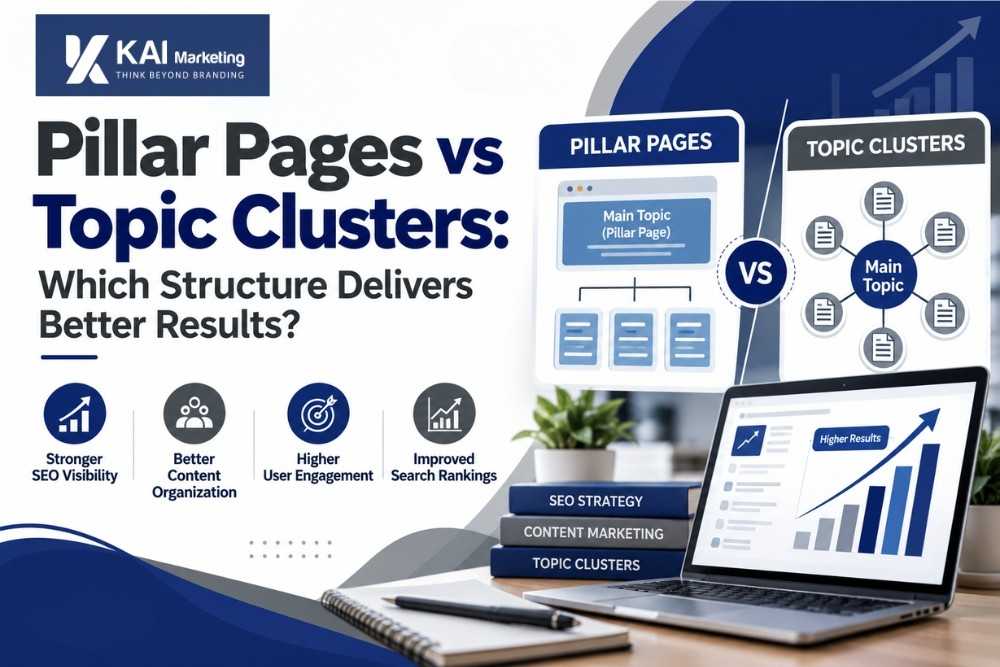
A pillar page provides an overview of one topic on a single URL. A topic cluster organizes related subtopics across multiple interconnected pages using strategic internal links. Pillar pages establish immediate topical breadth, while topic clusters build deep entity authority and long-tail visibility across competitive search landscapes.
Neither framework wins on its own. Modern search engines evaluate semantic connections, not isolated keywords. True organic growth occurs when you treat pillar pages as anchors and cluster assets as specialized spokes. Let us explore the mechanics behind both architectures, so your team invests with total clarity.
The Search Engine Shift: Why Structure Governs Organic Visibility
Modern retrieval engines index ideas through entity relationships rather than simple keyword density. Recent industry benchmarks show structured content architectures capture 43% higher conversion rates than disorganized corporate blogs. Disjointed articles confuse search crawlers and dilute topical authority.
When your digital library lacks clear taxonomy, readers bounce back to search results within seconds. Businesses partnering with an SEO agency in Duluth quickly recognize that semantic internal linking signals true topical mastery. Every internal hyperlink passes authority downward to niche subtopics.
Clear information grouping directly feeds generative discovery engines and traditional indexing bots. Organized entities protect your business against algorithmic updates. Precision architecture transforms idle impressions into qualified sales opportunities.
Pillar Pages And Topic Clusters Compared
Selecting the right content architecture depends on your operational goals and audience needs. Both options offer distinct technical advantages in today’s search ecosystem.
| Strategic Metric | Standalone Pillar Page | Comprehensive Topic Cluster |
|---|---|---|
| Search Intent | Broad informational discovery | Specific transactional and commercial intent |
| Indexing Speed | Rapid initial indexing on a single URL | Incremental authority growth across subpages |
| Audience Depth | High-level survey of overarching topic | Deep technical coverage of specialized problems |
| Maintenance Cost | Low ongoing administrative updates | Continuous optimization across linked assets |
| Conversion Pathway | Direct top-of-funnel lead magnets | Targeted middle-of-funnel sales inquiries |
Standalone pillar pages deliver fast clarity for broad search queries. In contrast, comprehensive topic clusters answer customer questions at every stage of the buying journey.
Building An Authority Engine With Unified Architecture
True organic visibility rarely forces an either-or decision. Smart teams combine both frameworks into a unified authority system. You build a central pillar to capture broad attention, then surround it with targeted cluster articles.
- Map Your Central Pillar Topic. Select an umbrella theme that directly reflects your core commercial offering. In our enterprise implementations, we found that selecting topics with clear buyer intent prevents wasted editorial effort.
- Identify High-Intent Subtopic Questions. Uncover specific pain points through customer interviews and generative search patterns. In our client audits, we found that answering exact transactional questions early boosts engagement by over 30%.
- Execute Contextual Internal Linking. Connect each child asset back to the parent pillar using descriptive semantic anchors. When engineering an SEO strategy that generates leads, your hyperlinks must reflect natural reading paths rather than mechanical keyword repetition.
- Deploy AI-Ready Content Hubs. Structure your supporting assets to satisfy conversational search queries and voice prompts. AI-powered content clusters ensure your answers surface directly within generative answer overviews.
This interconnected network demonstrates comprehensive subject mastery to search crawlers. Each child article serves as an entry point, guiding readers to your central commercial hub.
Real-World Scenarios: Architecture In Practice
A regional industrial supplier in Georgia struggled with stagnant organic discovery. Their website contained sixty unconnected articles detailing warehouse automation techniques. Prospective buyers landed on random posts, grew confused by fragmented explanations, and left without contacting sales.
KAI Marketing audited the domain and restructured their disorganized content library. We transformed their primary landing page into an authoritative pillar covering modern warehouse logistics. Next, our team organized their existing articles into three thematic clusters connected by deliberate hyperlink paths.
Within five months, their inbound discovery expanded significantly. Organic inquiries rose greatly because enterprise buyers could navigate smoothly from introductory concepts to technical specifications. Systematically establishing structured authority mapping and topic clusters removes buyer friction across every digital touchpoint.
When individual articles reinforce a central theme, search algorithms recognize your domain as authoritative. Clarity replaces confusion, turning passive browsing into confident action.
Strategic Timing: When To Deploy Each Structure
Deploy a standalone pillar page when launching a new service category that requires rapid indexing. This format serves early-stage researchers who need quick overviews before exploring technical nuances. A single pillar also simplifies initial asset creation when marketing budgets remain tightly constrained.
Transition into full topic clusters when entering competitive markets dominated by legacy publishers. Cluster networks allow you to capture specific long-tail queries that competitors overlook. Over time, these focused articles insulate your brand against search shifts by establishing verifiable topical depth.
- Choose Pillar Pages For: Product announcements, comprehensive guides, and foundational industry glossaries.
- Choose Topic Clusters For: Competitive commercial keywords, complex B2B buying cycles, and multi-stage customer journeys.
- Combine Both Frameworks When: Scaling organic pipeline, targeting regional enterprise accounts, and dominating generative search answers.
Planning your site hierarchy prevents costly rewrites later. Thoughtful pacing ensures every piece of published content supports your bottom line.
Frequently Asked Questions
Which Structure Ranks Faster On Search Engines?
Pillar pages rank faster for broad informational terms because search engines evaluate a single consolidated URL. Topic clusters require several weeks to build authority across interconnected child pages. However, topic clusters generate more consistent aggregate traffic over time by winning numerous specific long-tail searches.
Can Small Businesses Succeed With Only Pillar Pages?
Small businesses can achieve initial visibility using standalone pillar pages for broad local services. However, relying exclusively on single pages leaves competitive long-tail search volume open to competitors. Expanding into focused clusters eventually becomes necessary to capture buyers searching for specific solutions.
How Many Supporting Articles Belong In A Single Cluster?
A standard topic cluster typically contains five to eight tightly focused supporting articles. Each supporting page must address a distinct user question without overlapping other cluster assets. Adding unnecessary articles dilutes internal link equity and confuses search crawler indexing priorities.
What Mistakes Break Topic Cluster Performance?
The most common mistake is linking cluster articles randomly, without a logical parent-child hierarchy. Irrelevant internal links confuse crawler algorithms and scatter authority away from the main pillar. Teams should also avoid targeting the same search queries across multiple cluster articles to prevent keyword cannibalization.
How Does Site Architecture Impact AI Search Overviews?
Clear information architecture lets AI models extract precise entity relationships effortlessly. Interconnected clusters provide the contextual evidence AI algorithms require to cite sources inside generated overviews. Unstructured websites rarely earn citations because automated scrapers can’t determine their topical connections.
Build Your Organic Foundation
Disorganized content drains resources and confuses potential clients. The right architecture turns your digital presence into an enduring commercial asset. As a premier digital marketing company in Duluth, KAI Marketing designs deliberate content ecosystems that build trust and drive sustainable business growth.
Partner with a digital marketing agency in Duluth that prioritizes clarity over buzzwords. Contact KAI Marketing today for an architecture review, and let us turn your technical expertise into measurable market leadership.